
Variable at 3.19%, 25-year fixed at 3.83% - and a central bank that has just resumed hiking
In June 2026, new mortgage loan agreements recorded by the BCL, including renegotiations, amounted to approximately €567 million. More than half of this amount — €295 million — was at a variable rate.
This figure deserves closer attention. In June, the variable rate had the lowest average among the different interest-rate fixation periods published by the BCL, at 3.19%. It is also the only rate that can change, and it does so in a particular context: the ECB Governing Council raised its key interest rates by 25 basis points on 11 June, before keeping them unchanged on 23 July. Money markets are still pricing in approximately 40 basis points of additional rate increases by the end of 2026.
In other words, a significant share of Luxembourg borrowers is currently choosing the cheapest option at the very moment the cost of that option is trending upward. This article breaks down what the official figures - from the BCL and the BCE - actually say, and what they mean for a first-time purchase.
The essentials in 30 seconds ⏱️
- Variable rate: 3.19% in June 2026, up 9 basis points month-on-month - but down 9 points year-on-year.
- 20-25 year fixed rate: 3.83%, up 25 basis points month-on-month. The gap with the variable rate reaches 64 basis points.
- Volume split: 52% of the amounts borrowed in June were on a variable rate, 33% on fixed periods of over 10 years.
- Monetary policy: the ECB raised its rates on 11 June 2026 (deposit rate at 2.25%), then held on 23 July. Markets expect ~40bp of further hikes by end-2026.
- Eurozone inflation: 2.8% in June, including 8.5% for energy. The ECB judges inflation risks to be tilted to the upside.
- Volumes: new variable-rate loans fell by €111 million year-on-year. Mortgage demand is declining across the eurozone.
Rates in Luxembourg in June 2026: the full picture
The BCL publishes monthly average rates charged by Luxembourg credit institutions on new contracts, including renegotiations. Here is the state of the market, published on 3 August 2026:
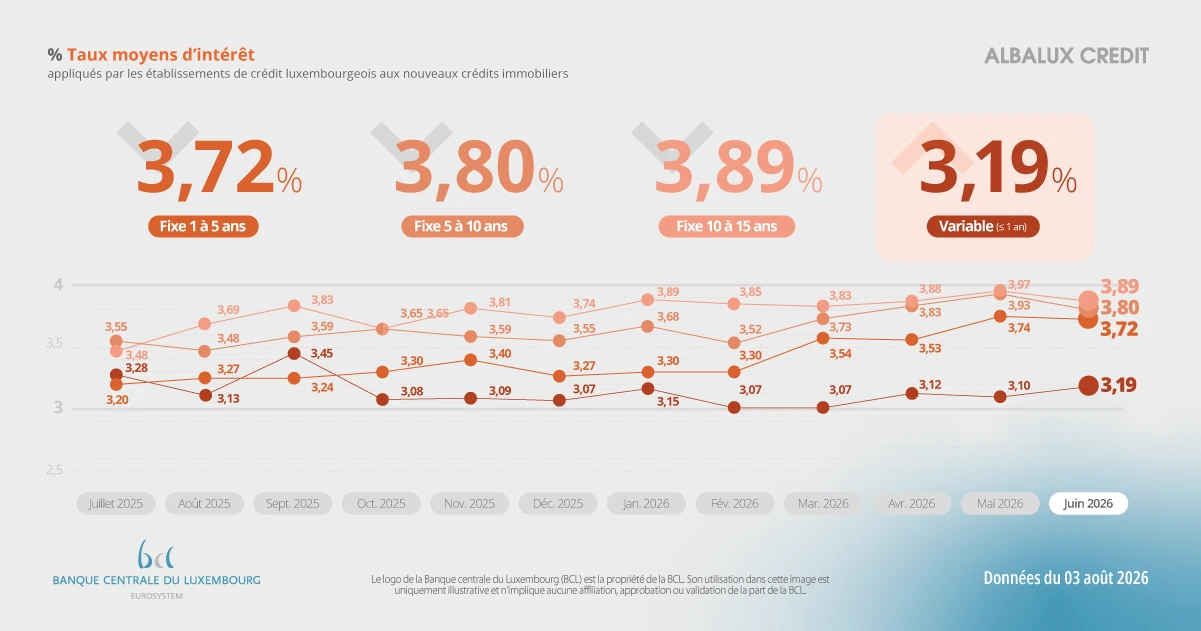
Source: BCL, press release of 3 August 2026, provisional June 2026 data. Fixed periods above 10 years represent a total monthly volume of €185m.
Two observations that don't make the headlines.
The variable rate is rising, but remains lower than a year ago. The 9-basis-point monthly increase masks a 9-point decline over twelve months. A borrower comparing their rate to a neighbour's who signed in summer 2025 won't see a deterioration. The turning point is recent, and it's monthly.
Volumes tell a different story than rates. New variable-rate loans jumped from €212 million to €295 million between May and June - but are down €111 million year-on-year. The Luxembourg credit market is contracting in trend, with significant monthly swings. The ECB observes the same phenomenon across the eurozone: mortgage demand has declined, against a backdrop of weakening consumer confidence and higher interest rates.
The variable/fixed trade-off, priced on a real case
Take a couple borrowing €500 000 over 25 years - a realistic amount for a three-bedroom flat in the outer suburbs. At June 2026 average rates:
| Choice | Rate | Monthly payment (excl. insurance) |
|---|---|---|
| Variable | 3,19 % | €2 421 |
| 25-year fixed | 3,83 % | €2 592 |
| Gap | 64 bp | €172 /month |
Over twelve months, the gap comes to €2,064 - roughly one month's rent in the capital.
But the exercise only makes sense if you project the anticipated rise. If the variable rate absorbs the ~40 basis points that money markets expect by the end of 2026, it would rise to around 3.59%, pushing the monthly payment to €2,527. The gap with the fixed rate would then narrow to €66 - without disappearing.
This is the heart of the decision, put simply: the initial difference is 64 basis points in favour of the variable rate. However, the break-even point between the two options depends on the future path of interest rates, when those changes occur, and the outstanding loan balance. Beyond that point, the variable rate becomes more expensive — unless the contract includes an interest-rate cap, a variable-rate loan exposes the borrower to higher monthly repayments when its reference index rises.
This arithmetic doesn't tell you what to choose. It tells you what the question looks like. A household with a debt-to-income ratio of 33% on the variable rate and 36% on the fixed rate isn't making the same trade-off as a household at 25% either way: the first is buying borrowing capacity by accepting risk, the second is buying comfort. Albalux Crédit has no default position on the variable rate - the right call depends on the borrower's profile, holding horizon and budget flexibility, and that's precisely what a broker is there to calculate.
Why is the fixed-rate curve so inconsistent?
An attentive reader of the table will have spotted an anomaly: the 15-20 year fixed rate stands at 4.02%, while the 20-25 year rate is at 3.83%. Borrowing for longer would therefore cost less. Economically, that makes no sense.
The explanation is methodological, and the BCL states it itself: the published rates for each bracket are volume-weighted averages, calculated across a sample of banks. When a bracket covers only a handful of loans in a given month, a single large loan on negotiated terms is enough to shift the average by several dozen basis points.
The signal is visible in the monthly variations themselves: +25bp on the 20-25 year bracket, -13bp on the 25-30 year bracket, +18bp on the 15-20 year bracket, all within the same month. No rate market moves this erratically in thirty days. These are composition effects, not price movements.
The practical consequence is direct: these figures serve to frame an order of magnitude - "long fixed rates run around 3.8 to 4.0%" - and absolutely not to choose a fixation period. A borrower who extended their fixed period from 20 to 25 years thinking they'd gain 19 basis points based on this table would be misreading the data. The rate that matters is the one their bank offers them, on their own file, with their own deposit and income.
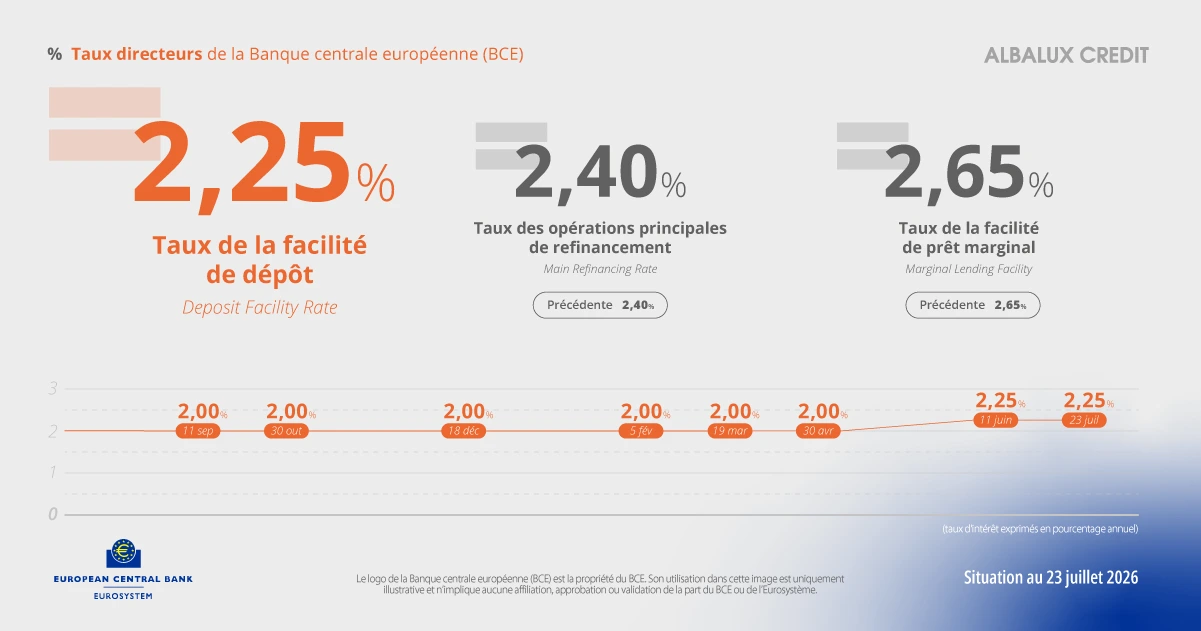
Source: ECB, press release of 23 July 2026. Key interest rates in effect since 17 June 2026: deposit facility rate at 2.25%, main refinancing operations rate at 2.40%, and marginal lending facility rate at 2.65%. Next monetary policy decision expected on 10 September 2026.
What the ECB is doing, and why
The sequence is unusual and worth understanding, because it shapes everything else.
On 11 June 2026, the Governing Council raised all three key rates by 25 basis points. On 23 July, it held them steady. The deposit facility, main refinancing operations and marginal lending facility rates now stand at 2.25%, 2.40% and 2.65% respectively.
The trigger isn't growth, but energy. Inflation fell back to 2.8% in June 2026, from 3.2% in May, but energy price inflation still stands at 8.5%. And the source of the shock is geopolitical: oil prices currently sit 30% above their pre-conflict level, and gas prices 97% above, due to the war in the Middle East.
The ECB's stance is explicitly defensive. The Governing Council judges that risks to the inflation outlook are tilted to the upside, and considers it likely that rising energy prices will keep inflation well above target until the first half of 2027.
One point is worth stressing for a borrower: the Governing Council is not committing to any particular rate path and is proceeding meeting by meeting, based on the data. Any twelve-month rate projection, including those from banks, is therefore an assumption - not information.

The future of rates: three scenarios, and what will decide between them
This is the question a broker hears most often, and the honest answer starts by acknowledging that today it depends more on geopolitics than on economics. Here are the three trajectories shaping the debate, along with the indicators that will settle the matter.
Scenario 1 - Continued increases (the scenario currently priced in)
This is the assumption currently priced into the market: the €STR forward curve prices in roughly 40 basis points of cumulative hikes by the end of 2026.
The driver would be the persistence of the energy shock. The ECB has stated this without ambiguity: the longer energy prices stay elevated, the greater the risk they feed into broader inflation through indirect and second-round effects. The mechanism is already visible upstream in the price chain: energy producer price inflation reached 14.0% year-on-year in May, and energy import price inflation reached 41.6%.
Indicator to watch: the trajectory of European gas prices, which is tighter than that of oil. European gas storage levels remain historically low for the season, which prolongs the pressure.
Scenario 2 - Stabilisation then easing (conflict resolution)
This scenario briefly materialised in June. The memorandum of understanding signed between the United States and Iran on 17 June, providing for the restoration of shipping traffic through the Strait of Hormuz, had caused oil prices to fall - before renewed strikes and President Trump's announcement of the end of the ceasefire reversed the move.
The ECB explicitly identifies this path: inflation could turn out lower than expected if the conflict in the Middle East were durably resolved. In that case, falling energy prices would remove the main argument for further hikes.
Indicator to watch: traffic through the Strait of Hormuz. It had improved in late June before receding with the re-escalation. It's the most direct thermometer linking geopolitics to a Luxembourg monthly mortgage payment.
Scenario 3 - The Ukraine factor and other shocks
The ECB cites Russia's unjustified war against Ukraine as a major source of uncertainty, distinct from the Middle East conflict. Two further risks, rarely mentioned in the financial press, add to this:
- Trade tensions. These could further fragment global supply chains and restrict the supply of critical raw materials - an inflationary channel independent of energy.
- Climate. Extreme weather events, such as the current heatwaves, could push food prices up more than expected. A food shock would have the same effect on key rates as an energy shock.
What these scenarios mean, in practice
The three trajectories don't carry equal probability, and no one - not the ECB, not the banks, not a broker - is in a position to calculate it. What the context does allow us to say, however, is that the range of possible outcomes is wider than usual right now. The ECB says as much itself: uncertainty remains elevated and the full inflationary impact of the energy shock has yet to fully play out.
A high-dispersion environment doesn't automatically make the fixed rate superior. It does, however, make any financing plan built on a single assumption costly. A robust loan file in 2026 is one that remains sustainable under Scenario 1 - not one optimised for Scenario 2.

Three consequences for a loan application
- The stress test is no longer a formality - it's the central calculation. Before comparing 3.19% and 3.83%, the useful question is: what happens to the monthly payment if the variable rate reaches 4.2%? On €500,000 over 25 years, it rises to around €2,691 - €270 more than today. A household that can absorb that amount without difficulty approaches the variable rate from a position of strength. A household for whom that extra €270 would break the budget needs to recognise that they're buying €172 a month in exchange for a risk they can't actually absorb.
- Banks are tightening, and it shows in more than just the rate. Mortgage lending criteria tightened in the second quarter of 2026, with banks growing more concerned about the economic risks facing their clients and less willing to take on risk themselves. A rejection or a downgraded counter-offer doesn't necessarily mean the file was weak - the thresholds have shifted. This is also why shopping the application around several institutions now produces bigger differences than during a period of uniform lending policy.
- Savings are better rewarded than they used to be. A point rarely picked up from the BCL release: the rate on household term deposits with an initial maturity of one year or less rose from 1.60% in May to 1.82% in June 2026 - a 36-basis-point increase year-on-year. For a couple building up their deposit over twelve to eighteen months, precautionary savings left in a non-interest-bearing current account now represent a measurable opportunity cost.
Frequently asked questions
According to the BCL, in June 2026 the average variable rate on new contracts stood at 3.19%. Fixed rates ranged from 3.72% (1-5 year fixation) to 4.02% (15-20 year fixation), with the 20-25 year fixed rate at 3.83%. These figures are volume-weighted averages across a sample of banks and don't predetermine the rate offered on an individual application.
The ECB raised its key rates on 11 June 2026, then held them on 23 July. Money markets expect roughly 40 further basis points of hikes by the end of 2026, driven by the energy shock linked to the Middle East conflict. Any easing would require a durable resolution of the conflict and a normalisation of energy prices. The ECB explicitly states it is not committing to any rate path.
The average gap currently stands at 64 basis points in favour of the variable rate (3.19% versus 3.83% for a 25-year fixed), or roughly €172 a month on a €500,000 loan over 25 years. The variable rate remains advantageous as long as the cumulative increase stays below that gap. The right answer depends on the debt-to-income ratio, the expected holding period for the property, and the household's capacity to absorb a rate increase — it can't be deduced from the headline rates alone.
Because the rates published by bracket are volume-weighted averages calculated across a sample of banks. When a bracket covers few loans in a given month, a handful of atypical loans is enough to shift the average. These inversions are statistical effects, not rates genuinely on offer.
The BCL publishes a monthly release on interest rates applied to new contracts, with a roughly two-month lag. The full data series is available in the Capital markets and interest rates section of the BCL website.
In summary
Three figures sum up the Luxembourg market this summer 2026: 3.19% for the variable rate, 3.83% for a 25-year fixed, and 40 further basis points of hikes expected by markets by December.
The 64-basis-point gap between variable and fixed is real, and represents €172 a month on a €500,000 loan. It isn't free: it buys a risk whose source today is less economic than geopolitical, and whose timing even the ECB acknowledges it doesn't control.
In this context, the relevant question isn't "what rate can I get?" but "what rate remains sustainable if the unfavourable scenario plays out?" That's a calculation, not an intuition — and it needs to be made before the viewing, not after signing the preliminary sales agreement.
Preparing a first purchase in Luxembourg? Albalux Crédit puts the local banks in competition, calculates your monthly payment under all three rate scenarios, and positions you with an agreement in principle before negotiations begin. Request a free, no-obligation simulation.
Official sources
- Banque centrale du Luxembourg - Taux d'intérêt, press release of 3 August 2026 (provisional June 2026 data)
- BCL - Séries statistiques : marchés de capitaux et taux d'intérêt
- European Central Bank - Economic Bulletin, Issue 5/2026, published 6 August 2026 (also available in French)
- BCE - Décisions de politique monétaire du 23 juillet 2026
- Virgule.lu - Les taux variables des crédits immobiliers poursuivent leur hausse au Luxembourg, press coverage of the BCL release
The monthly payments shown are calculated using the constant-annuity method, excluding borrower insurance, arrangement fees and guarantees, based on the average rates published by the BCL. They are illustrative and do not constitute an offer. Albalux Crédit is not an investment adviser: the choice between a fixed and a variable rate is a personal decision, made in light of the borrower's full circumstances.